INDEPENDENT TECHNICAL JUDGMENT · FRACTIONAL CTO
95% of AI pilots deliver zero return.The other 5% had someone technicaljudging what to buy — and what to kill.
Independent technical judgment for founders making expensive AI, software and engineering decisions.
I work for the company buying the technology, not the vendor selling it. No commission, no referral fee, no revenue share.
01/07 · A VENDOR PROPOSES:
PROPOSALA forecasting model that learns your sign-up rhythm and alerts when the flow breaks
PRICESix and a half months of engineering time
CLAIM“Predicts each hour's volume; flags anything outside the band”
THE NUMBER YOU GOT2.26M records, twelve years — and not one labelled anomaly
1 OF 7 · NO VERDICT YET
View as list01/07
- BUILD
- A forecasting model that learns the normal rhythm of our incoming sign-ups and alerts us the moment the flow breaks.
- PRICE
- Six and a half months of engineering time — 11 scripts and 2 notebooks, roughly 1,300 lines of work.TIMELINEThe evaluation ran 3 March to 20 September 2023, in three bursts of work.
- CLAIM
- “The model predicts each hour's expected volume and flags anything outside the predicted band.”
- THE NUMBER YOU GOT
- No accuracy number for anything. Twelve years of sign-up history, 2.26 million records, and not one labelled anomaly in it — so every method was judged by eye, on plots.
- OMAR’S CALL
- KILL
Six months of models ended up where a three-line average-and-spread check started, and the heavy models found only the total outages that the simple check had already caught.
THE QUESTION I’D HAVE ASKED FIRST:
Before we build the model — run the simplest rule you can write in an afternoon, and tell me what it misses.
02/07
- BUILD
- Before locking in the model that reads your tender documents, spend two days benchmarking seven of them on twenty of your own documents — with the answer key written by three-model consensus, not by hand.
- PRICE
- About fifteen dollars of model spend and two days of work.TIMELINETwo days to build and run — 24–25 March 2026. The report was regenerated on 31 July 2026 as new models appeared.
- CLAIM
- “You will know what each model actually scores on your documents, and what each one costs you per document.”
- THE NUMBER YOU GOT
- Before the eval, nothing. Production had been reading tender documents since 11 February 2026 on a model picked as a default, with no measurement of how well it did on a single real Bosnian tender.
- OMAR’S CALL
- BUY
Two days of work and about fifteen dollars of model spend showed the cheap model reads these documents almost as well as the expensive one, and that is not something a public leaderboard can tell you.
THE QUESTION I’D HAVE ASKED FIRST:
Forget the leaderboard — what does each model score on twenty of your own documents, and what does each one cost you per document?
WHAT HAPPENEDThe eval ran first and drove the switch. Production moved to the small model. The top scorer costs 3.3 times more per document for 4.6 points of quality; the most expensive model of all scored lower than both. At 1,000 to 10,000 documents a month, that gap is roughly $90 to $900 a month.
03/07
- BUILD
- Stay on the current setup. The token bill is the cost of running the product; grow into it.
- PRICE
- The monthly AI bill itself — the running cost of leaving the setup alone.TIMELINEPlanned and built 17–25 October 2025; dual mode and the migration framework completed 20 October 2025.
- CLAIM
- “Every reply needs the full configuration in front of it, or the assistant goes off-script.”
- THE NUMBER YOU GOT
- An itemised token budget for one request — 7,250 tokens, of which 6,500 were the rulebook (shop config 1,000, every conversation flow 3,000, every guideline 2,000, the glossary 500) sent on every single message whether the conversation touched them or not.
- OMAR’S CALL
- SWITCH
The old setup posted the entire rulebook with every message; sending only the page actually in use cuts roughly four fifths of the token bill, and any customer can be put back on the old setup with one flag.
THE QUESTION I’D HAVE ASKED FIRST:
Itemise one request. What is in there that most requests never use?
WHAT HAPPENEDShipped. The monthly AI bill came down by 60 to 80 percent.
04/07
- BUILD
- A full experimentation platform for the marketing site: a dedicated experiments collection, block-level and whole-page variants, automatic significance testing, an embedded results dashboard, and traffic that reallocates itself toward the winner.
- PRICE
- Priced in my own build time — the design-to-shipped span ran 30 Jul to 5 Sep 2025, in two working bursts.TIMELINEThe simpler version I shipped instead was scoped in its own document as "implement in hours, not weeks."
- CLAIM
- “Marketers can manage experiments themselves — significance, conversion tracking and a winner recommendation handled for them, with no speed cost, because variants render on the server.”
- THE NUMBER YOU GOT
- Nothing. No experiment had ever run on the site. There was no result to weigh, only a guess about who would use the thing.
- OMAR’S CALL
- KILL
The people who would actually run the tests write pages, not code, and nothing in the elaborate version was something they could operate without me.
THE QUESTION I’D HAVE ASKED FIRST:
Who makes the second version of the page — an engineer, or the person who wrote the first one?
WHAT HAPPENEDKilled in three and a half hours on 30 Jul 2025 and replaced with one mechanic: duplicate the page, edit the copy, publish; traffic splits 50/50 and results are read in the analytics tool.
05/07
- BUILD
- Convert a client's lead-generation content platform to a static site. Same pages, no server — cheaper hosting, faster loads, and it cuts the front end loose from the back end.
- PRICE
- Framed as the cheap option — a conversion, not a rebuild.
- CLAIM
- “It is only a hosting change. Ship the same site as static files and drop the server entirely.”
- THE NUMBER YOU GOT
- A read of the actual code, not a demo: the front end's build step reads the back end's config file directly, and 32 content block types carry 42 server-side processors that hold back-end secrets and prepare data before anything renders.
- OMAR’S CALL
- BUY, ESCALATED
The cheap version turned out to cost most of a rebuild and would have left them owning the same tangle at the end of it, so I told them to pay for the rebuild instead.
THE QUESTION I’D HAVE ASKED FIRST:
If the shortcut costs most of what the rebuild costs, what do we actually own when it is finished?
WHAT HAPPENEDApproved. The rebuild went ahead.
06/07
- BUILD
- Keep going on the two-sided marketplace. It is the most built thing I own — five years of work, 6,151 source files, 274 database migrations, live merchant shops on a running cluster. Finish the last stretch and grow it.
- PRICE
- Four to six weeks of hardening before it could be pushed, then continuous operations — the heaviest running load of anything in the portfolio, for one person. Infrastructure was the small number: about €135 a month for the cluster that carried it and everything else.
- CLAIM
- “It is nearly finished and it is already live. Walking away wastes five years.”
- THE NUMBER YOU GOT
- A scoring pass I ran on my own portfolio, weighted for the only thing that mattered once I admitted nothing was earning yet: time to first revenue ×3, defensibility ×3, fit for a solo operator ×2, market size ×1. The marketplace scored 21. The procurement product scored 49.
- OMAR’S CALL
- KILL
It was the most finished thing I had and the slowest to earn a single payment, and I only saw that once I scored it against the others instead of against its own backlog.
THE QUESTION I’D HAVE ASKED FIRST:
Which of these could take a real payment this week?
WHAT HAPPENEDSunset. The marketplace was demoted to controlled harvest, an internal CRM and two other side projects were shelved outright, and the procurement product became the lead.
07/07
- BUILD
- Cost every job in the product before any code exists, put a meter and a daily cap in first, and route each job to the cheapest tier that clears it — reserving the top model for the calls that actually need it.
- PRICE
- The top tier lists at 60 times the cheapest one, per token — $15 and $75 per million tokens in and out, against $0.25 and $1.25. The product sells for $19 a month.TIMELINEThe architecture and the costed plan were written in one day, 23 May 2026. Four hours later the cost ledger and a hard cap of fifty cents per user per day were in the code. The first model call ran the following night.
- CLAIM
- “The bulk of the product runs at one-sixtieth the token price, and the expensive model works only where it earns its cost.”
- THE NUMBER YOU GOT
- Ten jobs, costed one by one before any code existed: what each one does, how often it runs per user per month, and what it costs on each tier. Two of the ten needed the top tier, and both run once a week. The costed plan came to $1.53 of model spend per user per month against a $19 subscription, with a margin floor of 60 percent I set for myself.
- OMAR’S CALL
- BUY
I put the meter in before the first model call, so I could see which two jobs were worth the expensive tier and put the other eight on the cheapest one that cleared the bar.
THE QUESTION I’D HAVE ASKED FIRST:
Before we pick a model — where is the meter, and what is the daily limit per user?
All seven turned on a question asked before the money moved. If one of these is on your desk now, that is what the call is for.
Read all seven as a list ↓Rung 01 below is this, run on your own live decision.
1.0
Who this is for
01
Founders without a technical co-founder
You sign for work you cannot check. Every quote reads as reasonable, and nobody is paid to say which one is.
02
Owners who depend on an agency
The agency writes the proposal, prices it, and then marks its own homework. You need a second reader.
03
Leaders under pressure to do something with AI
The board wants AI on the roadmap. You want to know which part is real, and what it costs to keep running.
2.0
Engagements
Three ways to access the same judgment — no tiers, no programs, no discovery decks. Say what’s on your desk and you get the engagement that fits, number and timeline included.
What’s on your desk?
01 IF ONE DECISION BLOCKS YOU
Decision Review
2 WEEKS
One live decision — a proposal, a quote, an architecture — judged against what it will actually cost you. You get a written decision memo and the questions to put to your vendor.
02 IF THE STACK NEEDS JUDGING
Technical Assessment
3–4 WEEKS
Your stack, your vendors and your roadmap, read end to end. You get a written assessment, a ranked list of what to fix first, and the cost of leaving each one alone.
03 CONTINUING OVERSIGHT
Fractional CTO Retainer
3-MONTH MINIMUM
A senior technical read on decisions as they arrive. You get a standing review of vendor work, a working session every fortnight, and someone to call before you sign.
Full prices and terms for all three engagements, plus the sample audit. One email, no sequence.
Everything paid for 01 is credited in full against 02 within 90 days.
TERMSDOWNLOAD PDF
- FEE
- fixed, invoiced 50/50 · full rates on the rate card
- DURATION
- stated per engagement above · retainer 3-MONTH MINIMUM
- FORMAT
- written memo + one working session
- PAYMENT
- bank transfer, EU and US entities
- WHAT YOU GET
- listed per engagement
- NEUTRALITY
- no commission, referral fee or revenue share from any vendor
- AVAILABILITY
- ONE NEW ENGAGEMENT PER MONTH · NEXT START SEPTEMBER
3.0
What I deliberately don’t do
- 01I don’t write the code. Implementation stays with your team or your vendor.
- 02I don’t run day-to-day engineering management, hiring or performance reviews.
- 03I don’t resell, implement or take a fee on any tool I recommend.
- 04I don’t write strategy decks. Every engagement ends in a decision you can act on.
- 05I don’t take work where I would end up judging something I built myself.
Senior judgment at the decision moment, not another pair of hands.
4.0
Evidence
Here is the arithmetic most pilot proposals skip:
- 120,000
- calls a month
- ×
- 3,400
- tokens a call
- =
- 408,000,000
- tokens a month
- ×
- $3.00
- per M input tokens
- =
- $1,224
- a month, to run
Below this line the pilot pays for itself; above it, it quietly doesn’t.
Rung 02 above runs this arithmetic across a whole stack, not one line of it.
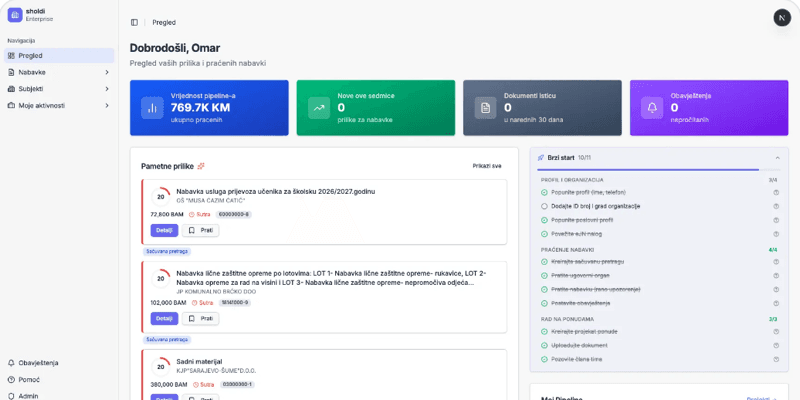
- ROLE
- Designed, built, shipped, operated
- WHAT IT DOES
- AI analysis of public tenders in Bosnia and Herzegovina
- IN PRODUCTION
- since 2025
- LIVE AT
- sena.ba (opens in a new tab)
FIG. 4SAMPLE DECISION MEMOCOMING THIS MONTH
NOTESCOMING SOON
FIG. 4SAMPLE DECISION MEMO — COMING THIS MONTHNOTES — COMING SOON
Client work is confidential; I publish method and artifacts instead of quotes. No commission, referral fee or revenue share from any vendor — a term of every engagement, in the terms above.
5.0
About
- 01 Early builder
- 02 Agency founder
- 03 The Toptal decade
- 04 Founder and CTO of Sena.ba

I started at fifteen, with a social network I wrote for people I knew. It passed fifty thousand users before I understood what that meant, and I have been building for other people ever since.
Then a web agency in Sarajevo, which I founded and ran. I wrote the quotes, defended the estimates, and paid for the ones I got wrong. That is where I learned to price work honestly.
A decade at Toptal followed: around fifteen major international clients, as Principal Engineer, then Engineering Manager, then Architect, and most recently as Distinguished Engineer.
I co-founded an e-commerce platform. Today I am Founder and CTO of Sena.ba, which I designed, built and still run: Claude, GPT and Gemini in a multi-model agentic pipeline, kept affordable to run.
CAREER
- 01Social network at fifteen, 50,000+ users
- 02Web agency in Sarajevo
- 03Around fifteen international consulting clients
- 04Principal Engineer
- 05Engineering Manager
- 06Architect
- 07Most recently Distinguished Engineer
- 08Co-founded an e-commerce platform
- 09Founder and CTO of Sena.ba
CLAUDE CERTIFIED ARCHITECT — FOUNDATIONS · ANTHROPIC EDUCATION · VALID TO 2026-11-22 · VERIFY
6.0
Questions
Why part-time — don’t we need someone committed?
Most decisions that go wrong did not need forty hours a week. They needed one senior read at the right moment. I take one new engagement a month so that read is unhurried, and you pay for judgment rather than for a seat.
Why remote, and why someone in Europe?
I work from Sarajevo, on CET, which overlaps a full working day with Europe and half of one with the US east coast. Everything I produce is written down, so the work does not depend on being in the room.
Why not just use an agency?
An agency writes the proposal, prices it, and then marks its own homework. I do not implement what I recommend and I take nothing from the vendor, so there is no version of this where I gain by telling you to buy.
What does it cost to find out if this is a fit?
The first call is free and takes thirty minutes. If it is not a fit I will say so on that call. If it is, the smallest engagement is the fixed price stated in rung 01 above, and everything paid for it is credited against the next one.
One decision reviewed before you sign it can pay for this several times over.
ONE NEW ENGAGEMENT PER MONTH · NEXT START SEPTEMBER